

Tel: 0512-66958483
Email: engforlife-mkt@efl-tech.com

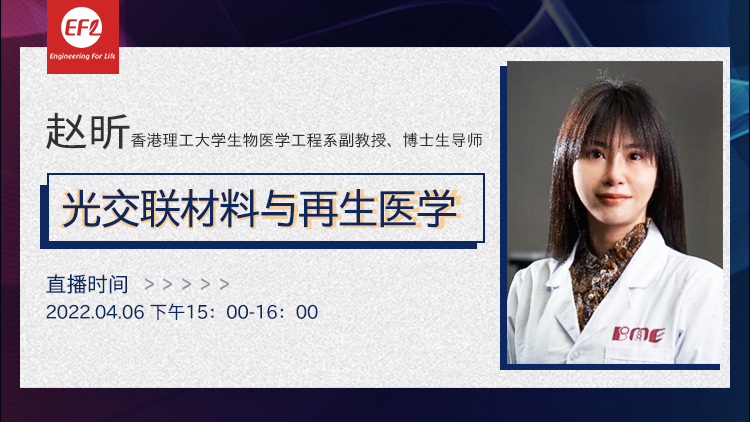

讲师简介:
赵昕博士现为香港理工大学生物医学工程系副教授, 博士生导师。赵博士团队致力于工程学、生物学、医学等多学科交叉领域中的基础及应用研究工作,主要研究兴趣包括生物活性材料、靶向药物递送、组织工程支架、器官芯片等。截止目前,在Nat. Mater.、Proc. Natl. Acad. Sci. USA、Mater. Today、Adv. Funct. Mater.、Biomaterials、Small等国际期刊发表论文100余篇,论文累计总引用5000余次,H指数为39(Google Scholar Citations),6篇论文入围“ESI高被引论文”。作为主要申请人主持国家自然科学基金优秀青年科学基金项目(港澳)、香港研究资助局、香港创新科技署及香港食物及卫生局科研项目总计10余项,共计受资助1500余万港币。此外,赵博士获得《自然》杂志2019年“自然科研-励志科学奖”(Nature Research Awards for Inspiring Science)提名(全球范围总共评选10位);作为香港地区唯一代表,获2018年国际医学与生物工程联合会亚太研究网络奖(International Federation of Medical and Biological Engineering(IFMBE)Asia Pacific Research Networking(APRN)Fellowship),并做大会特邀报告;获得香港理工大学2018年度教员杰出表现成就奖以及2019年度工程学院研究成果奖。此外,她负责的“光交联纳米复合仿生植骨材料”项目获得2021年日内瓦国际发明奖银奖。赵博士还担任中国英文期刊《Engineered Regeneration》创刊主编和《Bio-Design and Manufacturing》副主编,同时也是11本SCI学术期刊编委,先后共主编或参编Elsevier、Wiley-VCH等出版社书籍7本;举办或参与举办国际学术会议3次,并应邀在国内外学术会议作主题或邀请报告30余次;申请中国专利6项(已授权3项),美国专利1项。
讲座摘要:
Photocrosslinkable polymers are polymers that can be solidified from liquid upon light exposure. They have been employed to fabricate tissue engineered constructs due to the mild conditions for crosslinking, highly tunable mechanical and structural modifiability, printability, biodegradability and biocompatibility. These biomaterials can maintain their structural integrity after biofabrication and provide topological, biochemical, and physical cues to guide cellular behaviors by creating a biomimetic microenvironment.
The emphasis of this talk is placed on how photocrosslinkable polymers can be used to achieve regeneration of diseased or damaged tissues, for example, their fabrication into various scaffolds (electrospun fibers, microspheres, and 3D printed scaffolds) to reconstruct hard tissues like bone as well as soft tissues such as skin. Specifically, assisted by microfluidics, we have developed photocrosslinkable methacrylated gelatin (GelMA) based microspheres encapsulating human mesenchymal stem cells (MSCs) for bone repair. Due to the mild crosslinking conditions, we found that the GelMA microspheres can provide a favourable micro-environment for MSC survival, spreading, migration, proliferation and osteogenesis. In another study, we prepared a periosteum mimicking bone aid (PMBA) by electrospinning photocrosslinkable GelMA with L-arginine-based unsaturated poly(ester amide) (Arg-UPEA), and methacrylated hydroxyapatite nanoparticles (nHAMA). Upon light exposure, the resultant hydrogel fibrous scaffolds can solidify within seconds. Via controlling the crosslinking density, we can control the scaffolds’ mechanical and degradation property. The optimal scaffold was found to provide long term structural and functional support and mediation of physiological activity. With the aid of 3D printing, we developed 3D bone scaffolds made of photocrosslinkable nanocomposite ink consisting of tri-block poly (lactide-co-propylene glycol-co-lactide) dimethacrylate (PmLnDMA, m and n respectively represent the unit length of propylene glycol and lactide) and nHAMA. It is discovered that nHAMA can rapidly interact with PmLnDMA upon light exposure within 140 seconds and form an inorganic-organic co-crosslinked nanocomposite network. This bone ink was found to provide good mechanical strength and bioactivity for bone regeneration.

 首页
 试剂/耗材
 电话咨询


